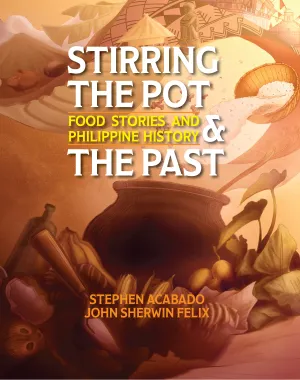
Stirring the Pot & The Past: Food Stories and Philippine History

Author(s)
Stephen Acabado, John Sherwin Felix
Edition
1
Pages
200
Book Type
Academic

CHOOSE YOUR FORMAT

Help Me Choose

Paperback Book

$60.00

ISBN: 9798319749826
Details: 
Print Product

eBook

$42.00

ISBN: 9798319749833
Details: 
Electronic Delivery EBOOK - 365 days

CHOOSE YOUR FORMAT

Help Me Choose

Paperback Book

$60.00

ISBN: 9798319749826
Details: 
Print Product

eBook

$42.00

ISBN: 9798319749833
Details: 
Electronic Delivery EBOOK - 365 days

Stirring the Pot and the Past uses food as a way into Philippine history. Adobo, sinigang, laing, kare-kare, tinola, sisig, balut, and other dishes become starting points for stories about Indigenous and local knowledge, trade, migration, colonial experiences, and identity. Archaeology and history sit alongside family stories, recipes, and photographs, showing how ingredients travel, how dishes change, and how food connect generations and places.

This book also turns attention to the people involved in bringing food to the table –farmers, fishers, vendors, cooks, and food-business owners. From Bicol and Manila to Hawaii and Los Angeles, the stories move between research and memories of cooking, migration, and family life, showing how everyday choices shape what Filipinos eat.

Stephen Acabado

Stephen B. Acabado is Professor of Anthropology at UCLA. He is an anthropological archaeologist whose research examines Indigenous histories, agriculture, colonialism, and human-environment relations. His long-term research in Ifugao, northern Philippines, challenged the widely repeated claim that the Cordillera Rice Terraces are 2,000 years old. Archaeological evidence instead places their expansion within the last several centuries and connects the development of wet-rice farming with social and political changes during the Spanish colonial period. His research draws from archaeology, ethnography, ethnohistory, and spatial analysis and has taken him to the Philippines, Taiwan, Cambodia, and Morocco. Across these regions, he studies how communities shape landscapes, maintain food systems, respond to political and environmental change, and draw on local knowledge. Acabado also develops archaeological training and capacity-building programs and writes for public audiences about archaeology, food, heritage, climate, and Philippine history.

John Sherwin Felix

John Sherwin Felix is a food researcher and the founder of Lokalpedia, an online archive of Philippine foodways. His research has taken him across Luzon, Visayas, and Mindanao, where he documents ingredients, dishes, cooking methods, markets, farms, fishing communities, and the people who keep local food traditions going. He spends much of his time talking with farmers, fishers, cooks, vendors, and home cooks, learning how ingredients are grown, gathered, prepared, preserved, and shared. His work follows the connections between food and place, as well as the histories and memories carried through everyday meals. Through Lokalpedia, he records ingredients and practices that often receive little attention outside the communities where they are found. He is particularly interested in how local knowledge is passed from one generation to another and how changes in farming, fishing, markets, and eating habits affect what ends up on Filipino tables. His writing and research bring these stories to a wider audience while documenting the range of food traditions found across the Philippines.

I have always admired Stephen Acabado’s sharp and insightful writing in his books and articles, and I truly believe food writing is in his heart. As a father raising his family in Los Angeles while holding key academic positions, his social media posts show how he nurtures his family with food and love. In Stirring the Pot and The Past, he skillfully dispels outdated myths, revealing that our food is a living archive of our history. With the eye of an archaeologist and the heart of a home cook, Stephen reveals how every dish carries the story of our people’s journey and survival. John Sherwin Felix’s photo-ethnography centers on the hands, sweat, and spirit of our farmers, cooks, and vendors, honoring the quiet labor and deep memory in every Filipino kitchen. We desperately need more books like this. Filipino food literature needs works that explore our history while remaining ­ fiercely, soulfully true to our roots. 

--Ige Ramos 

Founding Director, Ugnayan Center for Filipino Gastronomy


In “Stirring the Pot and the Past: Food Stories and Philippines History”, Stephen Acabado offers a rich feast that blends and dramatizes taste and time, flavor and fervor, home and away. Written for Filipinos in the global diaspora, “Stirring the Pot” utilizes archeological, biographical, and historical texts to cook up the provenances and evolution of dishes, ingredients, and other foodways. The “stirring” recipes and stories evoke nostalgic longings while providing intellectual sustenance and depth. Acabado, a famous Filipino archeologist, digs deep into layers of personal and national trajectories in order to evoke the travails and travel of Filipinos and their food as they continue to confront the culinary legacies of the past and the continuing emergence of Philippine cuisine as a global phenomenon. Expansive, approachable, and bountiful, much like a Filipino buffet, this book welcomes everyone to the table to savor, remember, and experience this commensal treat that is being offered.” 

--Martin F. Manalansan IV 

Professor, Rutgers University 

Stirring the Pot and the Past uses food as a way into Philippine history. Adobo, sinigang, laing, kare-kare, tinola, sisig, balut, and other dishes become starting points for stories about Indigenous and local knowledge, trade, migration, colonial experiences, and identity. Archaeology and history sit alongside family stories, recipes, and photographs, showing how ingredients travel, how dishes change, and how food connect generations and places.

This book also turns attention to the people involved in bringing food to the table –farmers, fishers, vendors, cooks, and food-business owners. From Bicol and Manila to Hawaii and Los Angeles, the stories move between research and memories of cooking, migration, and family life, showing how everyday choices shape what Filipinos eat.

Stephen Acabado

Stephen B. Acabado is Professor of Anthropology at UCLA. He is an anthropological archaeologist whose research examines Indigenous histories, agriculture, colonialism, and human-environment relations. His long-term research in Ifugao, northern Philippines, challenged the widely repeated claim that the Cordillera Rice Terraces are 2,000 years old. Archaeological evidence instead places their expansion within the last several centuries and connects the development of wet-rice farming with social and political changes during the Spanish colonial period. His research draws from archaeology, ethnography, ethnohistory, and spatial analysis and has taken him to the Philippines, Taiwan, Cambodia, and Morocco. Across these regions, he studies how communities shape landscapes, maintain food systems, respond to political and environmental change, and draw on local knowledge. Acabado also develops archaeological training and capacity-building programs and writes for public audiences about archaeology, food, heritage, climate, and Philippine history.

John Sherwin Felix

John Sherwin Felix is a food researcher and the founder of Lokalpedia, an online archive of Philippine foodways. His research has taken him across Luzon, Visayas, and Mindanao, where he documents ingredients, dishes, cooking methods, markets, farms, fishing communities, and the people who keep local food traditions going. He spends much of his time talking with farmers, fishers, cooks, vendors, and home cooks, learning how ingredients are grown, gathered, prepared, preserved, and shared. His work follows the connections between food and place, as well as the histories and memories carried through everyday meals. Through Lokalpedia, he records ingredients and practices that often receive little attention outside the communities where they are found. He is particularly interested in how local knowledge is passed from one generation to another and how changes in farming, fishing, markets, and eating habits affect what ends up on Filipino tables. His writing and research bring these stories to a wider audience while documenting the range of food traditions found across the Philippines.

I have always admired Stephen Acabado’s sharp and insightful writing in his books and articles, and I truly believe food writing is in his heart. As a father raising his family in Los Angeles while holding key academic positions, his social media posts show how he nurtures his family with food and love. In Stirring the Pot and The Past, he skillfully dispels outdated myths, revealing that our food is a living archive of our history. With the eye of an archaeologist and the heart of a home cook, Stephen reveals how every dish carries the story of our people’s journey and survival. John Sherwin Felix’s photo-ethnography centers on the hands, sweat, and spirit of our farmers, cooks, and vendors, honoring the quiet labor and deep memory in every Filipino kitchen. We desperately need more books like this. Filipino food literature needs works that explore our history while remaining ­ fiercely, soulfully true to our roots. 

--Ige Ramos 

Founding Director, Ugnayan Center for Filipino Gastronomy


In “Stirring the Pot and the Past: Food Stories and Philippines History”, Stephen Acabado offers a rich feast that blends and dramatizes taste and time, flavor and fervor, home and away. Written for Filipinos in the global diaspora, “Stirring the Pot” utilizes archeological, biographical, and historical texts to cook up the provenances and evolution of dishes, ingredients, and other foodways. The “stirring” recipes and stories evoke nostalgic longings while providing intellectual sustenance and depth. Acabado, a famous Filipino archeologist, digs deep into layers of personal and national trajectories in order to evoke the travails and travel of Filipinos and their food as they continue to confront the culinary legacies of the past and the continuing emergence of Philippine cuisine as a global phenomenon. Expansive, approachable, and bountiful, much like a Filipino buffet, this book welcomes everyone to the table to savor, remember, and experience this commensal treat that is being offered.” 

--Martin F. Manalansan IV 

Professor, Rutgers University 

Other Titles from this Author(s)

No other titles found of this author