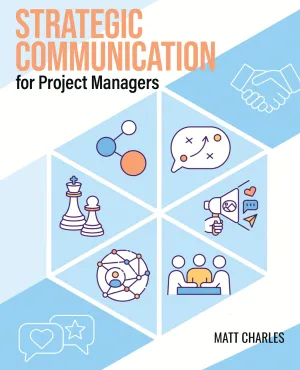
Strategic Communication for Project Managers

Author(s)
Matt Charles
Edition
1
Pages
76
Book Type
Academic

CHOOSE YOUR FORMAT

Help Me Choose

Paperback Book

$40.00

ISBN: 9798319744876
Details: 
Print Product

eBook

$30.00

ISBN: 9798319744883
Details: 
Electronic Delivery EBOOK - 365 days

CHOOSE YOUR FORMAT

Help Me Choose

Paperback Book

$40.00

ISBN: 9798319744876
Details: 
Print Product

eBook

$30.00

ISBN: 9798319744883
Details: 
Electronic Delivery EBOOK - 365 days

Strategic communication in project management aligns messaging with project goals and stakeholder needs to drive buy-in and mitigate risk. It involves identifying audiences, structuring inbound and outbound information flows and utilizing specifically tailored communication techniques to control the flow of information.

  • A successful strategic communication approach relies on several highly actionable steps:
  • Stakeholder Identification: Segment audiences into core groups:
    • Project team
    • Governance (project sponsors)
    • End-user (stakeholders-analyze each's expectations, influence and preferred frequency of updates)
  • Tailored Channels: Implement a mix of communication techniques that include:
    • Interactive: Real-time discussions (e.g., Microsoft Teams or Zoom) for sensitive issues and teams across time zones.
    • Push: Pushing data (e.g., email newsletters or formal status reports) without requiring immediate feedback.
    • Pull: Providing self-serve access (e.g., project dashboards in tools like Jira or Asana, or knowledge bases).
  • Proactive Planning: Define what is communicated, by whom, and when.
  • Inbound & Outbound Management: Manage both the information you push to executives (those controlling project budget) and the crucial feedback you pull from stakeholders.

One can break down workflow barriers and clear out logjams by integrating strategic communication into project management policies, processes and structures that make possible the following outcomes:

•Minimizing conflict and improving relationships through clear communication

• Mitigating risk

• Preventing crisis events

Strategic Communication for Project Managers provides a roadmap for accomplishing the desired job in an efficient, effective, and, hopefully, pain-free manner.

Matt Charles

Matt Charles is the former deputy spokesperson for the University of Virginia during and after the tragic Unite the Right rally in 2017, and many other crises. Prior to this position, he served the UVA Darden School of Business as director of media relations, helping the school earn a #1 ranking through his reputation management work. A frequent media spokesperson, crisis management/strategic communication professor and former New York City special investigator working sex and drug crimes involving children, he has provided training for the US Department of State, National Criminal Justice Command College and Drug Enforcement Administration, served on a working group for Washington, DC universities (Consortium 120) to combat gun violence, and has received Fulbright support. Professor Charles provides strategic counsel for institutions of higher education, government organizations, nonprofits, corporations, and small businesses and startups. He teaches, or has taught, for Georgetown University, the University of Virginia, American University, Northeastern University, the University of Maryland Global Campus, the University of Iowa, Rutgers University, the University of Florida, the University of Alabama and Purdue University.


Strategic communication in project management aligns messaging with project goals and stakeholder needs to drive buy-in and mitigate risk. It involves identifying audiences, structuring inbound and outbound information flows and utilizing specifically tailored communication techniques to control the flow of information.

  • A successful strategic communication approach relies on several highly actionable steps:
  • Stakeholder Identification: Segment audiences into core groups:
    • Project team
    • Governance (project sponsors)
    • End-user (stakeholders-analyze each's expectations, influence and preferred frequency of updates)
  • Tailored Channels: Implement a mix of communication techniques that include:
    • Interactive: Real-time discussions (e.g., Microsoft Teams or Zoom) for sensitive issues and teams across time zones.
    • Push: Pushing data (e.g., email newsletters or formal status reports) without requiring immediate feedback.
    • Pull: Providing self-serve access (e.g., project dashboards in tools like Jira or Asana, or knowledge bases).
  • Proactive Planning: Define what is communicated, by whom, and when.
  • Inbound & Outbound Management: Manage both the information you push to executives (those controlling project budget) and the crucial feedback you pull from stakeholders.

One can break down workflow barriers and clear out logjams by integrating strategic communication into project management policies, processes and structures that make possible the following outcomes:

•Minimizing conflict and improving relationships through clear communication

• Mitigating risk

• Preventing crisis events

Strategic Communication for Project Managers provides a roadmap for accomplishing the desired job in an efficient, effective, and, hopefully, pain-free manner.

Matt Charles

Matt Charles is the former deputy spokesperson for the University of Virginia during and after the tragic Unite the Right rally in 2017, and many other crises. Prior to this position, he served the UVA Darden School of Business as director of media relations, helping the school earn a #1 ranking through his reputation management work. A frequent media spokesperson, crisis management/strategic communication professor and former New York City special investigator working sex and drug crimes involving children, he has provided training for the US Department of State, National Criminal Justice Command College and Drug Enforcement Administration, served on a working group for Washington, DC universities (Consortium 120) to combat gun violence, and has received Fulbright support. Professor Charles provides strategic counsel for institutions of higher education, government organizations, nonprofits, corporations, and small businesses and startups. He teaches, or has taught, for Georgetown University, the University of Virginia, American University, Northeastern University, the University of Maryland Global Campus, the University of Iowa, Rutgers University, the University of Florida, the University of Alabama and Purdue University.